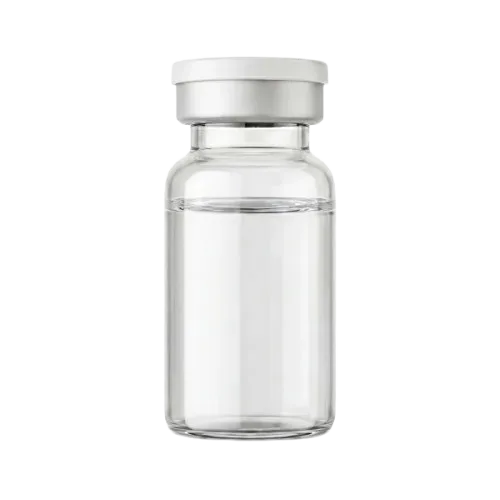
Types of water used in the laboratory
Distilled, demineralised and ultrapure water, and alongside them pharmaceutical preparations. We explain how these types differ and which one is a laboratory reagent.
The word "water" in a laboratory context covers several entirely different things - from an ancillary reagent to a medicinal product subject to pharmaceutical supervision. The distinction is not academic: it determines what a given preparation may be used for and who is allowed to sell it.
Distilled and demineralised water
Distilled water is produced by evaporation and condensation, which removes mineral salts and most non-volatile impurities. Demineralised (deionised) water achieves a similar result on ion exchange resins, where ions are captured by the bed. Both are typical ancillary reagents in laboratory work.
Neither is sterile by definition. Removing ions does not remove microorganisms or organic substances, so chemical purity and microbiological purity are two independent parameters.
Purity grades under ISO 3696
- Type III - water with the lowest requirements, for washing glassware and feeding instruments.
- Type II - water for most routine analytical applications.
- Type I - ultrapure water, for methods most sensitive to trace contamination.
The classification describes conductivity, organic carbon content and the presence of particles. It says nothing about sterility or about approval for any use in humans - that is an entirely separate axis of assessment.
Pharmaceutical preparations are a separate category
Alongside reagents there are water preparations with the status of a medicinal product: water for injection and bacteriostatic water, that is sterile water with an added preservative. They are sometimes confused with laboratory reagents because the description also contains the word "water", but they belong to a different legal order.
These are medicinal products: they are subject to registration, pharmaceutical supervision and requirements governing manufacture and distribution. They are not research reagents and you will not find them in a store offering RUO-grade materials, including ours. A supplier of research reagents is not an entity authorised to trade in medicinal products.
The practical conclusion: if you are looking for a pharmaceutical preparation, the right address is a pharmacy or a pharmaceutical wholesaler, not a reagent supplier. If, on the other hand, you need water as an ancillary reagent for laboratory work, the right category is laboratory-grade water.
What to look for when buying a reagent
- the declared type of water and how it was prepared,
- the volume and type of packaging,
- a batch number linking the package to its documentation,
- the storage conditions stated by the supplier.
Storage
Store water in its original, tightly closed packaging, away from heat and light. Treat an opened package as material with limited shelf life - contact with air means contact with contaminants and with carbon dioxide, which changes conductivity and pH.
We supply these materials for laboratory research use only (RUO) - not for consumption by humans or animals and not for clinical applications. They are not a medicine, a medicinal product or a dietary supplement.